


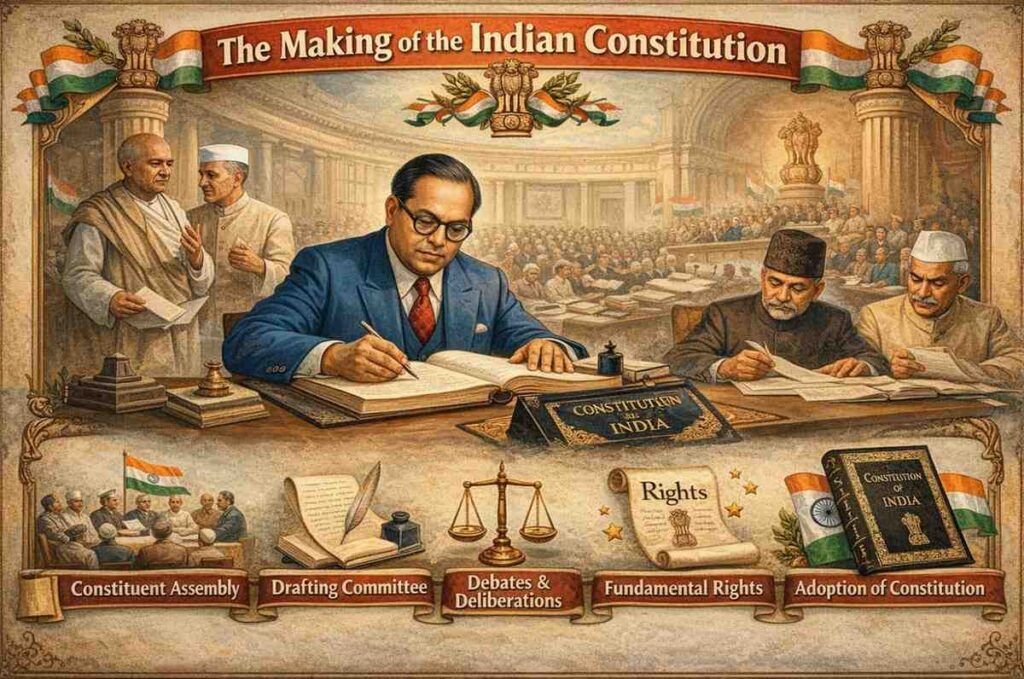
The Making of Indian Constitution
A. The Making of the Indian Constitution
The Indian Constitution was framed by the Constituent Assembly, which was formed under the Cabinet Mission Plan of 1946. The first meeting of the Constituent Assembly was held on 9 December 1946. After independence, the Assembly became fully sovereign and took responsibility for drafting the Constitution.
The Constituent Assembly consisted of 299 members, representing different provinces, communities, and princely states. Dr. B. R. Ambedkar, as the Chairman of the Drafting Committee, played a decisive role in shaping the Constitution. Several committees were formed to deal with specific issues such as fundamental rights, federal structure, and minority safeguards.
The Constitution was drafted after extensive debates and discussions lasting nearly three years. It was influenced by various sources, including the British Constitution, the U.S. Constitution, the Irish Constitution, and others. The final draft was adopted on 26 November 1949 and came into force on 26 January 1950.
The Indian Constitution reflects the ideals of justice, liberty, equality, and fraternity, making it a comprehensive and democratic framework for governing India.
Q1. Which body was entrusted with the responsibility of framing the Indian Constitution?
Answer: The Constituent Assembly.
Q2. In which country was the term “Constituent Assembly” first used?
Answer: France.
Q3. Who first demanded the formation of a Constituent Assembly?
Answer: Jawaharlal Nehru.
Q4. When did the Indian National Congress first demand a Constituent Assembly?
Answer: In 1906.
Q5. In which declaration did the Congress first demand a Constituent Assembly?
Answer: In the Swaraj-related declaration.
Q6. When did Mahatma Gandhi support the demand for a Constituent Assembly?
Answer: In 1922.
Q7. Who first demanded the framing of the Constitution?
Answer: M. N. Roy.
Q8. When did M. N. Roy demand the framing of the Constitution?
Answer: In 1934.
Q9. When did the Congress demand a Constituent Assembly based on adult franchise?
Answer: In 1934.
Q10. In which Congress session was the proposal to form a Constituent Assembly first adopted?
Answer: Faizpur Session, 1936.
Q11. When did the Indian National Congress first formally support the demand for a Constituent Assembly?
Answer: In 1938.
Q12. When did the Congress formally place the proposal for the formation of the Constituent Assembly?
Answer: In 1939.
Q13. In which Congress session was the proposal for a Constituent Assembly adopted for the second time?
Answer: Ramgarh Session, 1940.
Q14. When was the August Offer announced?
Answer: In 1940.
Q15. When did the British Government first agree to the formation of a Constituent Assembly?
Answer: On 7 August 1940.
Q16. When did the British Government first acknowledge the idea of forming a Constituent Assembly?
Answer: In 1942, through the Cripps Mission.
Q17. When did the Cripps Mission come to India?
Answer: In March 1942.
Q18. When was the Wavell Plan announced?
Answer: In June 1945.
Q19. When did the British Government accept the demand for a Constituent Assembly?
Answer: On 15 March 1946.
Q20. When did the British Government recognize India’s right to self-determination?
Answer: On 15 March 1946.
Q21. Which British Prime Minister sent the Cabinet Mission to India?
Answer: Clement Attlee.
Q22. When did the Cabinet Mission arrive in India?
Answer: On 24 March 1946.
Q23. Who were the members of the Cabinet Mission?
Answer: Stafford Cripps, Pethick-Lawrence, and A. V. Alexander.
Q24. What was the official status of the Cabinet Mission members?
Answer: All were British Cabinet Ministers.
Q25. When did the Cabinet Mission present its proposals?
Answer: On 16 May 1946.
Q26. Whose proposal did the Indians first accept for constitution-making?
Answer: The Cabinet Mission proposal.
Q27. When did the British Government formally announce the formation of the Constituent Assembly?
Answer: In May 1946.
Q28. When did the Congress accept the Cabinet Mission Plan?
Answer: On 25 June 1946.
Q29. When was the Interim Government formed in India?
Answer: In August 1946.
Q30. On the basis of which plan was the Constituent Assembly formed?
Answer: The Cabinet Mission Plan of 1946.
Q31. When were elections to the Constituent Assembly completed?
Answer: In July 1946.
Q32. What type of body was the Constituent Assembly?
Answer: A unicameral legislature.
Q33. What was the total strength of the Constituent Assembly?
Answer: 389 members.
Q34. How many seats were allotted to British Indian Provinces?
Answer: 296 seats.
Q35. How many seats were allotted to Chief Commissioner’s Provinces?
Answer: 4 seats.
Q36. How many members were nominated from the Princely States?
Answer: 93 members.
Q37. Which Princely State had the highest number of representatives?
Answer: Mysore (7 members).
Q38. How many seats were reserved for Chief Commissioner’s Provinces?
Answer: 4 seats.
Q39. Who was the only Communist member of the Constituent Assembly?
Answer: Somnath Lahiri.
Q40. Which political party did not participate in the Constituent Assembly?
Answer: The Communist Party of India.
Q41. How many representatives from Bengal were there in the Constituent Assembly?
Answer: 60 members.
Q42. How many basic principles guided the Constituent Assembly?
Answer: Four principles.
Q43. How many seats did the Congress win in the Constituent Assembly elections?
Answer: 208 seats.
Q44. What percentage of seats did the Congress secure in the Constituent Assembly?
Answer: 69 percent.
Q45. How many seats did the Muslim League win?
Answer: 73 seats.
Q46. How many women members were there in the Constituent Assembly?
Answer: 15 women.
Q47. Name some prominent women members of the Constituent Assembly.
Answer: Rajkumari Amrit Kaur, Sarojini Naidu, Sucheta Kripalani, Vijayalakshmi Pandit, among others.
Q48. Who was the only Bengali woman member of the Constituent Assembly?
Answer: Renuka Ray.
Q49. Who was the Bengali Communist member of the Constituent Assembly?
Answer: Somnath Lahiri.
Q50. Name some Bengali members of the Constituent Assembly.
Answer: Shyama Prasad Mukherjee, H. C. Mukherjee, Arun Chandra Guha, Manomohan Das, among others.
B. Constituent Assembly of India
Q51. How many members were there in the Constituent Assembly after independence?
Answer: 308 members.
Q52. Who was the temporary President of the Constituent Assembly?
Answer: Sachchidananda Sinha.
Q53. How many Vice-Presidents did the Constituent Assembly have?
Answer: Two Vice-Presidents.
Q54. Name one Vice-President of the Constituent Assembly.
Answer: Harendra Coomar Mukherjee.
Q55. Name another Vice-President of the Constituent Assembly.
Answer: V. T. Krishnamachari.
Q56. Who was the permanent President of the Constituent Assembly?
Answer: Dr. Rajendra Prasad.
Q57. Who was the Secretary of the Constituent Assembly?
Answer: H. V. R. Iyengar.
Q58. Who was the Deputy Secretary of the Constituent Assembly?
Answer: R. K. Khanna.
Q59. Who was the Under-Secretary of the Constituent Assembly?
Answer: Professor R. N. Banerjee.
Sessions of the Constituent Assembly
Q60. Under which plan was the first session of the Constituent Assembly held?
Answer: The Wavell Plan.
Q61. When was the first session of the Constituent Assembly held?
Answer: On 9 December 1946.
Q62. How many members were present in the first session?
Answer: 211 members.
Q63. Till which date did the first session continue?
Answer: Till 23 December 1946.
Q64. Who presided over the first session of the Constituent Assembly?
Answer: Sachchidananda Sinha.
Q65. Who moved the Objective Resolution in the Constituent Assembly?
Answer: Jawaharlal Nehru.
Q66. On which date did Nehru present the framework of the Constitution?
Answer: On 13 December 1946.
Q67. When was the second session of the Constituent Assembly held?
Answer: On 20 January 1947.
Q68. Till which date did the second session continue?
Answer: Till 25 January 1947.
Q69. When was the third session of the Constituent Assembly held?
Answer: On 28 April 1947.
Q70. Till which date did the third session continue?
Answer: Till 2 May 1947.
Q71. When was the fourth session of the Constituent Assembly held?
Answer: On 14 July 1947.
Q72. Till which date did the fourth session continue?
Answer: Till 31 July 1947.
Q73. When was the special session of the Constituent Assembly held?
Answer: At midnight on 14 August 1947.
Q74. When did the Constituent Assembly become a sovereign body?
Answer: On 15 August 1947.
Q75. When was the fifth session of the Constituent Assembly held?
Answer: On 20 August 1947.
Q76. Till which date did the fifth session continue?
Answer: Till 29 August 1947.
Q77. Which was the most important session of the Constituent Assembly?
Answer: The fifth session.
Drafting Committee
Q78. In which session was the Drafting Committee formed?
Answer: In the fifth session.
Q79. Who criticized the Drafting Committee most strongly?
Answer: Naziruddin Ahmad.
Q80. On which date was the Drafting Committee formed?
Answer: On 29 August 1947.
Q81. How many members were there in the Drafting Committee originally?
Answer: Seven members.
Q82. Which two persons were later included as new members of the Drafting Committee?
Answer: T. T. Krishnamachari and N. Madhava Rao.
Q83. Which two members left the Drafting Committee?
Answer: D. P. Khaitan (due to death) and B. L. Mitter (due to resignation).
Q84. Who was the only Bengali member of the Drafting Committee?
Answer: B. L. Mitter.
Q85. Name other members of the Drafting Committee.
Answer: G. S. Iyengar, A. K. Ayyar, K. M. Munshi, and Syed Mohammad Saadullah.
Q86. Who was the Chairman of the Drafting Committee?
Answer: Dr. B. R. Ambedkar.
Q87. From which province was Dr. B. R. Ambedkar first elected to the Constituent Assembly?
Answer: Bengal.
Later Sessions
Q88. When was the sixth session of the Constituent Assembly held?
Answer: On 27 January 1948.
Q89. When was the seventh session of the Constituent Assembly held?
Answer: On 4 November 1948.
Q90. Till which date did the seventh session continue?
Answer: Till 8 January 1949.
Q91. When was the eighth session of the Constituent Assembly held?
Answer: On 16 May 1949.
Q92. Till which date did the eighth session continue?
Answer: Till 16 June 1949.
Q93. When was the ninth session of the Constituent Assembly held?
Answer: On 30 July 1949.
Q94. Till which date did the ninth session continue?
Answer: Till 18 September 1949.
Q95. Which session was the longest session of the Constituent Assembly?
Answer: The seventh session.
Q96. When was the tenth session of the Constituent Assembly held?
Answer: On 6 October 1949.
Q97. Till which date did the tenth session continue?
Answer: Till 17 October 1949.
Q98. When was the eleventh session of the Constituent Assembly held?
Answer: On 14 November 1949.
Q99. Till which date did the eleventh session continue?
Answer: Till 26 November 1949.
Q100. How many total sessions were held by the Constituent Assembly?
Answer: Eleven sessions.
Constituent Assembly of India
C. Sessions, Duration & Adoption
Q101. How many days did the 11 sessions of the Constituent Assembly last in total?
Answer: 165 days.
Q102. When was the final session of the Constituent Assembly held?
Answer: On 24 January 1950.
Q103. Who presided over the final session of the Constituent Assembly?
Answer: Dr. Rajendra Prasad.
Q104. How many sessions were held before independence?
Answer: Four sessions (sometimes counted as five including a special session).
Q105. How many members signed the Constitution?
Answer: 284 members.
Q106. On which date did the members sign the Constitution?
Answer: On 24 January 1950.
Q107. When was the Constituent Assembly dissolved?
Answer: On 24 January 1950.
D. Committees of the Constituent Assembly
Q108. How many total committees were formed by the Constituent Assembly?
Answer: 22 committees.
Q109. How many procedural committees were there?
Answer: 10 committees.
Q110. How many subject-related committees were there?
Answer: 12 committees.
Q111. How many committees were considered most important?
Answer: 8 committees.
Q112. Who was the Chairman of the Provincial Constitution Committee?
Answer: Sardar Vallabhbhai Patel.
Q113. Who was the Chairman of the Union Constitution Committee?
Answer: Jawaharlal Nehru.
Q114. Who was the Chairman of the Rules of Procedure Committee?
Answer: Dr. Rajendra Prasad.
Q115. Who was the Chairman of the Committee for Negotiating with States?
Answer: Dr. Rajendra Prasad.
Q116. Who was the Chairman of the Steering Committee?
Answer: Dr. Rajendra Prasad.
Q117. Who was the Chairman of the Finance and Staff Committee?
Answer: Dr. Rajendra Prasad.
Q118. Who was the Chairman of the Ad Hoc National Flag Committee?
Answer: Dr. Rajendra Prasad.
Q119. Who was the Chairman of the Central Government Committee?
Answer: Jawaharlal Nehru.
Q120. Who was the Chairman of the Committee on Fundamental Rights and Minorities?
Answer: Sardar Vallabhbhai Patel.
Q121. Who was the Chairman of the Sub-Committee on Fundamental Rights?
Answer: J. B. Kripalani.
Q122. Who was the Chairman of the Sub-Committee on Minorities?
Answer: H. C. Mukherjee.
Q123. Who was the Chairman of the Advisory Committee on Tribal Areas?
Answer: A. K. Ayyar.
Q124. Who was the Chairman of the Order of Business Committee?
Answer: K. M. Munshi.
Q125. Who was the Chairman of the House Committee?
Answer: G. V. Mavlankar.
Drafting & Advisors
Q126. Who was the Chairman of the Drafting Committee?
Answer: Dr. B. R. Ambedkar.
Q127. Who was the Chief Constitutional Adviser to the Constituent Assembly?
Answer: B. N. Rau.
Q128. Who was the Constitutional Adviser of the Constituent Assembly?
Answer: B. N. Rau.
Q129. Who prepared the initial draft of the Constitution?
Answer: B. N. Rau.
E. Draft Constitution & Amendments
Q130. When did the Drafting Committee begin its work?
Answer: On 4 November 1947.
Q131. When did the Drafting Committee complete the Draft Constitution?
Answer: On 21 February 1948.
Q132. When was the first Draft Constitution presented to the Constituent Assembly?
Answer: On 22 February 1948.
Q133. How much time was given to the public to give suggestions on the first draft?
Answer: Eight months.
Q134. When was the second Draft Constitution presented?
Answer: In October 1948.
Q135. How many Articles and Schedules were there in the Draft Constitution?
Answer: 315 Articles and 13 Schedules.
Q136. How many amendments were proposed to the Draft Constitution?
Answer: 7,635 amendments.
Q137. How many amendments were discussed in the Constituent Assembly?
Answer: 2,473 amendments.
Q138. By which method were decisions taken in the Constituent Assembly?
Answer: By consensus.
F. Signing & Structure of the Constitution
Q139. Who was the first person to sign the Indian Constitution?
Answer: Dr. Rajendra Prasad.
Q140. How many members signed the Indian Constitution?
Answer: 284 members.
Q141. Who designed the calligraphy of the Indian Constitution?
Answer: Prem Behari Narain Raizada.
Q142. Who illustrated and decorated the Constitution of India?
Answer: Nandalal Bose and his team.
Q143. Who wrote the Constitution of India by hand?
Answer: Prem Behari Narain Raizada.
G. Articles, Schedules & Laws
Q144. How many Articles, Parts, and Schedules were there in the original Constitution?
Answer: 395 Articles, 22 Parts, and 8 Schedules.
Q145. How many Articles, Parts, and Schedules are there at present?
Answer: 448 Articles, 25 Parts, and 12 Schedules.
Q146. Under which Article was the Government of India Act, 1935 repealed?
Answer: Article 395.
Q147. Under which Article was the Indian Independence Act repealed?
Answer: Article 395.
Q148. Who described the Indian Constitution as very lengthy and complicated?
Answer: Ivor Jennings.
H. National Symbols & Important Dates
Q149. When was the National Flag of independent India adopted?
Answer: On 22 July 1947.
Q150. When was the Constitution adopted by the Constituent Assembly?
Answer: On 26 November 1949.
Q151. How long did it take to frame the Constitution?
Answer: 2 years, 11 months, and 17 days.
Q152. When was the National Anthem adopted?
Answer: On 24 January 1950.
Q153. In which session was the National Anthem adopted?
Answer: In the final session of the Constituent Assembly.
Q154. When did the Constitution of India come into force?
Answer: On 26 January 1950.
Q155. Who read the Proclamation of the Constitution on 26 January 1950?
Answer: Governor-General C. Rajagopalachari.
I. After the Constitution
Q156. What role did the Constituent Assembly play after 26 January 1950?
Answer: It functioned as the Provisional Parliament of India.
Q157. Who was the first Speaker of the Indian Parliament?
Answer: G. V. Mavlankar.
Q158. When did Jammu and Kashmir accede to India?
Answer: On 26 October 1947.
Q159. When was the Indian Constitution implemented in Jammu and Kashmir?
Answer: In 1954.
Q160. On which date is Constitution Day celebrated in India?
Answer: On 26 November.
Q161. Since which year has Constitution Day been officially observed?
Answer: Since 2015.
J. Important Personalities & Amendments
Q162. Who is called the father of the Preamble?
Answer: Jawaharlal Nehru.
Q163. Which two prominent leaders were not members of the Constituent Assembly?
Answer: Mahatma Gandhi and Muhammad Ali Jinnah.
Q164. Who was the interim President during the first session of the Constituent Assembly?
Answer: J. B. Kripalani.
Q165. When was India’s first Independence Day celebrated?
Answer: On 26 January 1930.
Q166. When was the Indian Constitution amended for the first time?
Answer: In June 1951.
Q167. How many times has the Indian Constitution been amended till 2020?
Answer: 104 times.
Q168. How many words are there in the English version of the Indian Constitution?
Answer: 117,369 words.
Q169. When did the Constituent Assembly finally cease to exist?
Answer: On 24 January 1950.