


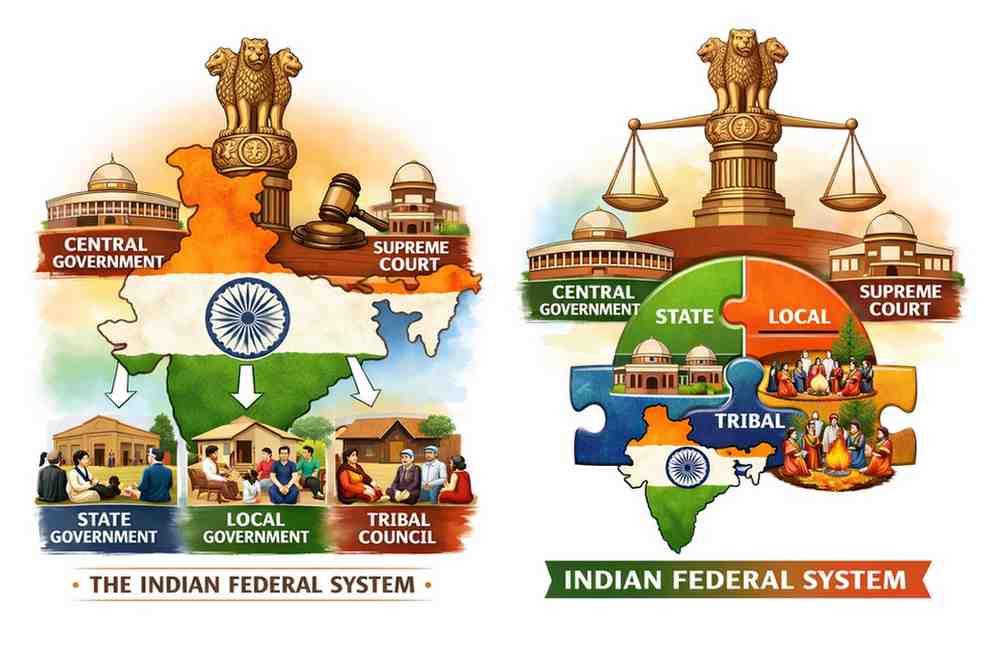
Indian Federal System
The Indian Federal System is a constitutional arrangement in which powers are divided between the Union (Central Government) and the States.
The Constitution of India clearly distributes subjects through the Union List, State List, and Concurrent List to ensure smooth governance.
Though federal in structure, the system has a strong central bias, making India a “quasi-federal” state.
India follows a unique federal system described in the Constitution as a “Union of States” under Article 1. The term reflects the intention of the framers to create an indestructible Union with no right of secession for the States. Though federal in structure, the Indian Constitution incorporates strong unitary features, making it a quasi-federal system.
The division of powers between the Centre and the States is provided under Article 246 and the Seventh Schedule through the Union, State, and Concurrent Lists. Unlike classical federations, residual powers in India are vested in the Centre under Article 248, strengthening central authority. Financial relations are governed by Articles 268–293, with the Finance Commission (Article 280) ensuring equitable distribution of resources.
Institutionally, the Supreme Court acts as the guardian of the Constitution and adjudicates Centre–State disputes under Article 131. Bodies such as the Inter-State Council and NITI Aayog promote cooperative federalism. Emergency provisions under Part XVIII further centralize power, transforming the system into a unitary one during crises.
Thus, Indian Federal System is dynamic, combining federal principles with a strong Centre to ensure unity, stability, and effective governance.
After Independence, India adopted a federal system to manage its vast diversity while maintaining national unity. The Constitution created a strong Centre with powers such as emergency provisions, All-India Services, and the authority to reorganize states, which helped in nation-building, integration of princely states, and maintaining political stability in the early years. Over time, linguistic reorganization of states and the growth of regional parties strengthened the federal spirit and increased the political importance of states.
In the contemporary period, Indian federalism orIndian Federal System has moved towards greater cooperative and competitive federalism, especially through institutions like the GST Council, NITI Aayog, and Finance Commissions. However, challenges remain, such as centralization of fiscal powers, disputes over the use of Article 356, role of Governors, and tensions between the Centre and opposition-ruled states. Overall, the Indian federal system has shown flexibility and resilience, continuously evolving to balance unity with regional autonomy in a changing political and economic context
Indian Federal System – Short Q&A
Q. Which country is called a quasi-federal state?
A. India.
1.Q. Where is the word “Federation” mentioned in the Indian Constitution?
A. It is not mentioned.
2. Where was the idea of a federal system first proposed in India?
A. Nehru Report, 1928.
3. What is the main basis of Indian federalism?
A. Government of India Act, 1935.
4.When was the federal structure first introduced in India?
A. In 1935.
Q. How is India described in the Constitution?
A. “Union of States”.
Q. Which Article mentions “Union of States”?
A. Article 1(1).
Q. From which country is the term “Union of States” borrowed?
A. Canada.
Q. From which country is the idea of federal system borrowed?
A. United States of America.
Q. Who described India as “federal in structure but unitary in spirit”?
A. Dr. A.M. Mukherjee.
Q. Who called India a “strong federation”?
A. Ivor Jennings.
Q. Who said India is a combination of unitary and federal system?
A. K.C. Wheare.
Q. Which are the four true federations according to K.C. Wheare?
A. USA, Canada, Australia, Switzerland.
Q. Who called Indian federalism a “poisoned seed”?
A. Goward.
Q. Who called India a “true federal system”?
A. Durgadas Basu.
Q. Who described Indian federalism as a “Novel Type”?
A. Durgadas Basu.
Q. Who called India a “strong centre federation”?
A. Ivor Jennings.
Q. Who described India as a “Tight Model of Federation”?
A. B.R. Ambedkar.
Q. Who called India a unitary state in practice?
A. K. Santhanam.
Q. Who described Indian federalism as a new type of federation?
A. G. Austin.
. India is described as what type of state in the Constitution?
A. A Union of States.
Q. Who described India as a “Soft State”?
A. Gunnar Myrdal.
Q. Who called the Indian Constitution “almost federal”?
A. K.C. Wheare.
Q. Residual powers are a feature of which system?
A. Federal system.
Q. Bicameral legislature is a feature of which system?
A. Federal system.
Q. Dual citizenship is a feature of which system?
A. Federal system (not accepted in India).
Q. Which system of government is characterized by the division of powers?
A. Federal system.
Q. Written and rigid constitution is a feature of which system?
A. Federal system.
Q. Independent constitution is a feature of which system?
A. Federal system (not accepted in India).
Q. Dual government is a feature of which system?
A. Federal system.
Q. Dual judiciary is a feature of which system?
A. Federal system (not accepted in India).
Q. Federal court is a feature of which system?
A. Federal system.
Q. Supremacy of the Constitution is a feature of which system?
A. Federal system.
Q. Equal representation of states is a feature of which system?
A. Federal system (not accepted in India).
Q. Indestructible states are a feature of which system?
A. Federal system (not accepted in India).
Q. Which institution resolves disputes between Centre and States?
A. Supreme Court.
Q. Which is the ideal federal country of the world?
A. United States of America.
Q. India is federal in normal times but unitary during emergency – who said this?
A. B.R. Ambedkar.
Q. Who called India a cooperative federation?
A. Morris Jones.
Q. Who enjoys residual powers in India?
A. Central Government / Parliament.
Q. From which country is the concept of residual powers borrowed?
A. Canada
Q. Who called India a Quasi-Federal state?
A. K.C. Wheare
Q. Who said India is basically federal?
A. Durgadas Basu.
Q. Who called India a fully federal system?
A. Ivor Jennings.
Q. Who called India a federation with a strong centre?
A. K.C. Wheare.
Q. Who described India as a federation with a strong central bias?
A. Ivor Jennings.
Q. Who said Indian Constitution is federal but has unitary features?
A. Durgadas Basu.
Q. Who said India is an indestructible union of destructible states?
A. Durgadas Basu.
Q. Where is the word “Federation” mentioned in the Indian Constitution?
A. It is not mentioned.
where was the idea of a federal system first proposed in India?
A. Nehru Report, 1928.
What is the main basis of Indian federalism?
A. Government of India Act, 1935.
When was the federal structure first introduced in India?
A. In 1935.
Q. How is India described in the Constitution?
A. “Union of States”.
Q. Which Article mentions “Union of States”?
A. Article 1(1).
Q. From which country is the term “Union of States” borrowed?
A. Canada.
Q. From which country is the idea of federal system borrowed?
A. United States of America.
Q. Who described India as “federal in structure but unitary in spirit”?
A. Dr. A.M. Mukherjee.
Q. Who called India a “strong federation”?
A. Ivor Jennings.
Q. Who said India is a combination of unitary and federal system?
A. K.C. Wheare.
Q. Which are the four true federations according to K.C. Wheare?
A. USA, Canada, Australia, Switzerland.
Q. Who called Indian federalism a “poisoned seed”?
A. Goward.
Q. Who called India a “true federal system”?
A. Durgadas Basu.
Q. Who described Indian federalism as a “Novel Type”?
A. Durgadas Basu.
Q. Who called India a “strong centre federation”?
A. Ivor Jennings.
Q. Who described India as a “Tight Model of Federation”?
A. B.R. Ambedkar.
Q. Who called India a unitary state in practice?
A. K. Santhanam.
Q. Who described Indian federalism as a new type of federation?
A. G. Austin.
21. India is described as what type of state in the Constitution?
A. A Union of States.
Q. Who described India as a “Soft State”?
A. Gunnar Myrdal.
Q. Who called the Indian Constitution “almost federal”?
A. K.C. Wheare.
Q. Which system of government is characterized by residual powers?
A. Federal system.
Q. Bicameral legislature is a feature of which system?
A. Federal system.
Q.Which system of government is characterized by dual citizenship?
A. Federal system (not accepted in India).
Q. Which system has division of powers as a feature?
A. Federal system.
Q. Written and rigid constitution is a feature of which system?
A. Federal system.
Q. Independent constitution is a feature of which system?
A. Federal system (not accepted in India).
Q. Dual government is a feature of which system?
A. Federal system.
Q. Dual judiciary is a feature of which system?
A. Federal system (not accepted in India).
Q. Federal court is a feature of which system?
A. Federal system.
Q. Supremacy of the Constitution is a feature of which system?
A. Federal system.
Q. Equal representation of states is a feature of which system?
A. Federal system (not accepted in India).
Q. Indestructible states are a feature of which system?
A. Federal system (not accepted in India).
Q. Which institution resolves disputes between Centre and States?
A. Supreme Court.
Q. Which is the ideal federal country of the world?
A. United States of America.
Q. Which country has a multi-level federal system?
A. India.
Q. India is federal in normal times but unitary during emergency – who said this?
A. B.R. Ambedkar.
Q. Who called India a cooperative federation?
A. Morris Jones.
Q. Who enjoys residual powers in India?
A. Central Government / Parliament.
Q. From which country is the concept of residual powers borrowed?
A. Canada.
Q. Who called India a Quasi-Federal state?
A. K.C. Wheare.
Q. Who said India is basically federal?
A. Durgadas Basu.
Q. Who called India a fully federal system?
A. Ivor Jennings.
Q. Who called India a federation with a strong centre?
A. K.C. Wheare.
Q. Who described India as a federation with a strong central bias?
A. Ivor Jennings.
Q. Who said Indian Constitution is federal but has unitary features?
A. Durgadas Basu.
Q. Who said India is an indestructible union of destructible states?
A. Durgadas Basu.
Q. Where is the word “Federation” mentioned in the Indian Constitution?
A. It is not mentioned.
Where was the idea of a federal system first proposed in India?
A. Nehru Report, 1928.
What is the main basis of Indian federalism?
A. Government of India Act, 1935.
When was the federal structure first introduced in India?
A. In 1935.
Q. How is India described in the Constitution?
A. “Union of States”.
Q. Which Article mentions “Union of States”?
A. Article 1(1).
Q. From which country is the term “Union of States” borrowed?
A. Canada.
Q. From which country is the idea of federal system borrowed?
A. United States of America.
Q. Who described India as “federal in structure but unitary in spirit”?
A. Dr. A.M. Mukherjee.
Q. Who called India a “strong federation”?
A. Ivor Jennings.
Q. Who said India is a combination of unitary and federal system?
A. K.C. Wheare.
Q. According to K.C. Wheare, how many countries are true federations?
A. Four.
Q. Which are the four true federations according to K.C. Wheare?
A. USA, Canada, Australia, Switzerland.
Q. Who called India a “true federal system”?
A. Durgadas Basu.
Q. Who described Indian federalism as a “Novel Type”?
A. Durgadas Basu.
Q. Who called India a “strong centre federation”?
A. Ivor Jennings.
Q. Who described India as a “Tight Model of Federation”?
A. B.R. Ambedkar.
Q. Who called India a unitary state in practice?
A. K. Santhanam.
Q. Who described Indian federalism as a new type of federation?
A. G. Austin.
India is described as what type of state in the Constitution?
A. A Union of States.
Q. Who described India as a “Soft State”?
A. Gunnar Myrdal.
Q. Who called the Indian Constitution “almost federal”?
A. K.C. Wheare.
Q. Residual powers are a feature of which system?
A. Federal system.
Q. Bicameral legislature is a feature of which system?
A. Federal system.
Q. Dual citizenship is a feature of which system?
A. Federal system (not accepted in India).
Q. Division of powers is a feature of which system?
A. Federal system.
Q. Written and rigid constitution is a feature of which system?
A. Federal system.
Q. Independent constitution is a feature of which system?
A. Federal system (not accepted in India).
Q. Dual government is a feature of which system?
A. Federal system.
Q. Dual judiciary is a feature of which system?
A. Federal system (not accepted in India).
Q. Federal court is a feature of which system?
A. Federal system.
Q. Supremacy of the Constitution is a feature of which system?
A. Federal system.
Q. Equal representation of states is a feature of which system?
A. Federal system (not accepted in India).
Q. Indestructible states are a feature of which system?
A. Federal system (not accepted in India).
Q. Which institution resolves disputes between Centre and States?
A. Supreme Court.
Q. Which is the ideal federal country of the world?
A. United States of America.
Q. Which country has a multi-level federal system?
A. India.
Q. India is federal in normal times but unitary during emergency – who said this?
A. B.R. Ambedkar.
Q. Which country is called a quasi-federal state?
A. India.
Q. Who called India a cooperative federation?
A. Morris Jones.
Q. Who enjoys residual powers in India?
A. Central Government / Parliament.
Q. From which country is the concept of residual powers borrowed?
A. Canada.
Q. Who called India a Quasi-Federal state?
A. K.C. Wheare.
Q. Who said India is basically federal?
A. Durgadas Basu.
Q. Who called India a fully federal system?
A. Ivor Jennings
Q. Who called India a federation with a strong centre?
A. K.C. Wheare.
Q. Who described India as a federation with a strong central bias?
A. Ivor Jennings.
Q. Who said Indian Constitution is federal but has unitary features?
A. Durgadas Basu.
Q. Who said India is an indestructible union of destructible states?
A. Durgadas Basu.
Q. Who described India as a unitary state in practice?
A. K. Santhanam.
Q. Who said Indian federalism has unitary bias?
A. J.C. Johari.
Q. Following which country, India is called a “Union of States”?
A. Canada
Q. From which country is India’s federal structure borrowed?
A. Canada.
Q. Which country is called a cooperative federation?
A. United States of America.
Q. In which federation can states not secede?
A. Cooperative federation.
Q. From where was the division of powers between Centre and States taken?
A. Government of India Act, 1935.
Q. Under which Article are Union, State and Concurrent Lists mentioned?
A. Article 246.
Q. In which Schedule are the three lists mentioned?
A. Seventh Schedule.
Q. How many lists are mentioned in the Seventh Schedule?
A. Three (Union, State, Concurrent).
Q. In which Part is the division of powers mentioned?
A. Part XI.
Q. Which Part deals with financial relations between Centre and States?
A. Part XII.
Q. Which Articles deal with financial distribution of powers?
A. Articles 264–293.
Q. Which Article mentions financial relations?
A. Article 264.
Q. Which Article mentions the Consolidated Fund of India?
A. Article 266.
Q. Who controls the Contingency Fund of India?
A. Parliament.
Q. Which Article mentions the Contingency Fund of India?
A. Article 267.
Q. When was the Contingency Fund established?
A. 1950.
Q. Who operates the Contingency Fund of India?
A. President of India.
Q. How is power divided between Centre and States in India?
A. Through Union, State and Concurrent Lists.
Q. How many subjects were in the Union List originally?
A. 97.
Q. How many subjects were in the Union List till 2016?
A. 100.
Q. When was the 100th subject added to the Union List?
A. 2003.
Q. What was the 100th subject added to the Union List?
A. Service Tax.
Q. Under which Article was Service Tax added to the Union List?
A. Article 268.
Q. Under which Constitutional Amendment was Service Tax added?
A. 88th Amendment Act, 2003.
Q. How many subjects are there in the Union List at present (2022)?
A. 100.
Q. When were two subjects removed from the Union List?
A. 2016.
Under which Amendment were two subjects removed from the Union List?
A. 101st Constitutional Amendment.
Q. Which two subjects were removed in 2016?
A. Advertisement tax & Service tax.
Q. Service tax was removed from Union List under which Amendment?
A. 101st Amendment Act, 2016.
Q. Name important subjects in the Union List.
A. Defence, Foreign Affairs, Banking, Currency, Railways, Elections.
Q. Mention some institutions under Union List.
A. RBI, CBI, Civil Aviation, Foreign Trade.
Q. How many Articles deal with revenue distribution?
A. 12 Articles (268–279).
Q. Which Article is related to GST?
A. Article 279A.
Q. Which tax is shared between Centre and States?
A. Income tax (except agricultural income).
Q. How many revenue-related subjects are in the Union List?
A. 13.
Q. Name revenue subjects in the Union List.
A. Excise duty, Corporation tax, Customs duty, Income tax (non-agricultural).
Q. How many subjects were in the Concurrent List originally?
A. 47.
Q. How many subjects are in the Concurrent List at present?
A. 52.
Q. Are there revenue subjects in the Concurrent List?
A. No.
Q. Name important subjects in the Concurrent List.
A. Education, Marriage, Criminal law, Electricity, Labour, Forests.
Q. How many subjects were in the State List originally?
A. 66.
Q. How many subjects are in the State List at present (2022)?
A. 61.
Q. When were two subjects removed from the State List?
A. 2016.
Q. Under which Amendment were two subjects removed from State List?
A. 101st Constitutional Amendment.
Q. Name important subjects in the State List.
A. Police, Public Health, Agriculture, Land, Local Government.
Q. How many revenue subjects are in the State List?
A. 19.
Q. Tax on land and buildings belongs to which list?
A. State List.
Q. Under the 42nd Amendment, how many subjects were transferred to Concurrent List?
A. Five
Q. Under which Amendment were Education, Forests and Population shifted to Concurrent List?
A. 42nd Constitutional Amendment, 1976.
Q. At present, Education belongs to which list?
A. Concurrent List.
Q. Before 1976, Education belonged to which list?
A. State List.
Q. The idea of Concurrent List is borrowed from which country?
A. Australia.
Q. Subjects not included in Union, State or Concurrent Lists are called what?
A. Residual Powers.
Q. Which Article deals with residual powers?
A. Article 248.
Q. Who decides whether a subject is residual or not?
A. Supreme Court.
Q. Who compared residual powers to “last resort power”?
A. Durgadas Basu.
Q. Under the Government of India Act, 1935, residual powers belonged to whom?
A. Governor-General.
Q. Who recommended inclusion of residual powers in Concurrent List?
A. Sarkaria Commission.
Q. In Jammu & Kashmir, residual powers belonged to whom?
A. State Legislature.
Q. Under which Article can Parliament establish additional courts?
A. Article 247.
Q. Under which Article can the Centre protect a State from external aggression?
A. Article 355.
Q. External aggression comes under which power?
A. Residual power (outside all three lists).
Q. From which country was the idea of giving residual powers to Centre borrowed?
A. Canada.
Q. Under which Article does the Centre have special responsibility towards States?
A. Article 355.
Q. Under which Article does the Centre protect States from external aggression?
A. Article 355.
Q. Under which Article does the Centre protect States from internal disturbance?
A. Article 355.
Q. Under which Article does the Centre ensure constitutional governance in States?
A. Article 355.
Q. Name major revenue sources of the Union Government.
A. Income tax (non-agricultural), Excise duty, Customs duty, Corporation tax.
Q. Name major revenue sources of State Governments.
A. Land revenue, Sales tax, Electricity tax, Vehicle tax, Agricultural income tax.
Q. Which taxes are levied by Centre but collected and appropriated by States?
A. Stamp duty, Excise on medicinal & toilet preparations.
Q. Which taxes are levied and collected by Centre but shared with States?
A. Income tax (non-agricultural), Estate duty (non-agricultural).
Q. Which taxes are shared between Centre and States?
A. Income tax (except agricultural), Union excise duties.
Q. How many units does the Indian Union have?
A. 28 States and 8 Union Territories.
Q. Financial assistance given by Centre to States is called what?
A. Grants-in-Aid.
Q. When was the first Finance Commission formed in British India?
A. 1921
Q. Under which Article is the Finance Commission constituted?
A. Article 280.
Q. When was India’s first Finance Commission constituted?
A. 1951.
Q. Who was the Chairman of the First Finance Commission?
A. K.C. Neogy.
Q. How many members are there in the Finance Commission?
A. Five (1 Chairman + 4 members).
Q. Who appoints the Finance Commission?
A. President of India.
Q. What is the tenure of the Finance Commission?
A. Five years.
Q. Which clause of Article 280 describes the functions of Finance Commission?
A. Article 280(3).
Q. To whom does the Finance Commission submit its report?
A. President of India.
Q. After how many years is the Finance Commission constituted?
A. Every five years.
Q. Who recommends revenue sharing between Centre and States?
A. Finance Commission.
Q. Who actually distributes revenue between Centre and States?
A. President of India.
Q. Who recommends grants-in-aid to States?
A. Finance Commission.
Q. Under which Article can Centre give grants to States?
A. Article 282.
Q. Is the Central Government bound to accept Finance Commission recommendations?
A. No.
Q. Decisions of Finance Commission are beyond judicial review – True or False?
A. True.
Q. Who called Finance Commission a quasi-judicial body?
A. B.N. Rau.
Q. Who described Finance Commission as impartial and objective?
A. M.V. Pylee.
Q. Who said Finance Commission acts as a link between Centre and States?
A. M.V. Pylee.
Q. How many Finance Commissions had submitted reports till 2020?
A. Fourteen.
Q. When was the 14th Finance Commission constituted?
A. 8 March 2015.
Q. Who was the Chairman of the 14th Finance Commission?
A. Y.V. Reddy.
Q. Y.V. Reddy belonged to which service?
A. IAS (Former RBI Governor).
Q. Who was the Secretary of the 14th Finance Commission?
A. Ajay Narayan Jha.
Q. Under which Article is the Inter-State Council mentioned?
A. Article 263.
Q. Who establishes the Inter-State Council?
A. President of India.
Q. When was the Inter-State Council established?
A. 1990.
Q. Who was the Prime Minister when the Inter-State Council was formed?
A. V.P. Singh.
Q. Who is the Chairman of the Inter-State Council?
A. Prime Minister of India.
Q. Who are the members of the Inter-State Council?
A. Chief Ministers of States and Administrators of UTs.
Q. What is the main function of the Inter-State Council?
A. Coordination and dispute resolution between Centre and States.
Q. Which Commission recommended the Inter-State Council?
A. Sarkaria Commission.
Q. Is the Inter-State Council a permanent body?
A. Yes.
Q. Does the Inter-State Council have advisory or binding powers?
A. Advisory.
Q. Which body resolves water disputes between States?
A. Inter-State River Water Disputes Tribunal.
Q. Under which Article can Parliament adjudicate inter-state water disputes?
A. Article 262.
Q. Which Act deals with inter-state water disputes?
A. Inter-State River Water Disputes Act, 1956.
Q. Can the Supreme Court interfere in water disputes?
A. No, if Parliament bars jurisdiction.
Q. Which Article bars Supreme Court jurisdiction in water disputes?
A. Article 262(2).
Q. Which Commission recommended strengthening Centre-State relations?
A. Sarkaria Commission.
Q. When was the Sarkaria Commission appointed?
A. 1983.
Q. Who was the Chairman of the Sarkaria Commission?
A. R.S. Sarkaria.
Q. When did the Sarkaria Commission submit its report?
A. 1988.
Q. How many recommendations were made by the Sarkaria Commission?
A. 247.
Q. Which Commission supported a strong Centre?
A. Sarkaria Commission.
Q. Which Commission recommended cooperative federalism?
A. Sarkaria Commission.
Q. Which Commission opposed excessive use of Article 356?
A. Sarkaria Commission.
Q. Under which Article is President’s Rule imposed?
A. Article 356.
Q. Who can recommend President’s Rule in a State?
A. Governor.
Q. What is President’s Rule also called?
A. State Emergency.
Q. What is the maximum duration of President’s Rule?
A. Three years (with parliamentary approval).
Q. Who approves President’s Rule?
A. Parliament.
Q. Which Article deals with Centre’s directions to States?
A. Article 256.
Q. Which Article allows Centre to give directions on railways?
A. Article 257.
Q. Which Article allows Centre to give directions during emergencies?
A. Article 353.
Q. Which Article gives Parliament power to legislate on State List during emergency?
A. Article 249.
Q. Which Article allows Parliament to legislate on State List in national interest?
A. Article 249.
Q. Which Article allows Parliament to legislate on State List if states consent?
A. Article 252.
Q. Which Article allows Parliament to legislate to implement international treaties?
A. Article 253.
Q. Which Article allows Parliament to legislate during President’s Rule?
A. Article 356.
Q. Which Article gives Centre power over All-India Services?
A. Article 312.
Q. Examples of All-India Services?
A. IAS, IPS, IFS.
Q. From which country is the concept of All-India Services borrowed?
A. Britain.
Q. Which Article deals with appointment of Governors?
A. Article 155.
Q. Who appoints the Governor?
A. President of India.
Q. Governor is the representative of whom?
A. Central Government.
Q. Who described the Governor as an agent of the Centre?
A. B.R. Ambedkar.
Q. Which Commission recommended fixed tenure for Governors?
A. Sarkaria Commission.
Q. What is the normal tenure of a Governor?
A. Five years.
Q. Can a Governor be removed before completion of tenure?
A. Yes.
Q. Who can remove the Governor?
A. President of India.
Q. Which Article allows Centre to reorganize States?
A. Article 3.
Q. Which Article protects State boundaries?
A. No Article fully protects them.
Q. Who called India an indestructible Union of destructible States?
A. D.D. Basu
Q. Which Article deals with the formation of new States?
A. Article 3.
Q. Can Parliament change the name of a State?
A. Yes.
Q. Is the consent of States mandatory for reorganisation?
A. No (only consultation required).
Q. Which body gives its opinion on State reorganisation?
A. Concerned State Legislature.
Q. Who has the final authority in State reorganisation?
A. Parliament.
Q. Which Article defines the executive power of the Union?
A. Article 73.
Q. Which Article defines the executive power of the State?
A. Article 162
Q. Which Article deals with disputes between Centre and States?
A. Article 131.
Q. Which court has original jurisdiction in Centre–State disputes?
A. Supreme Court.
Q. Can individuals file cases under Article 131?
A. No.
Q. What type of jurisdiction is used under Article 131?
A. Original jurisdiction.
Q. Which disputes are excluded from Article 131?
A. Water disputes (if barred by Parliament).
Q. Which Article deals with Public Service Commissions?
A. Article 315.
Q. Which Article allows creation of Joint State Public Service Commission?
A. Article 315(2).
Q. How many types of Public Service Commissions exist in India?
A. Three (UPSC, SPSC, Joint PSC)
Q. Who appoints the Chairman of UPSC?
A. President of India.
Q. Which Article deals with the appointment of Chief Ministers?
A. Article 164.
Q. Who appoints the Chief Minister of a State?
A. Governor.
Q. Which Article deals with the Council of Ministers in States?
A. Article 163.
Q. Council of Ministers is collectively responsible to whom?
A. State Legislative Assembly.
Q. Which Article deals with High Courts?
A. Article 214.
Q. Who appoints the Chief Justice of a High Court?
A. President of India.
Q. Which Article deals with transfer of High Court judges?
A. Article 222.
Q. Which Article deals with the superintendence of High Courts over lower courts?
A. Article 227.
Q. Which Article deals with the administrative relations between Centre and States?
A. Article 256.
Q. Which Article allows Centre to give directions to States?
A. Article 256.
Q. Which Article allows Centre to control State executive power?
A. Article 257.
Q. Which Article allows Centre to protect railways in States?
A. Article 257(2).
Q. Which Article allows Centre to deploy armed forces in States?
A. Article 355.
Q. Which Article allows Centre to intervene if constitutional machinery fails?
A. Article 356.
Q. Who can dissolve State Legislative Assembly?
A. Governor (on President’s approval).
Q. Which Amendment limited misuse of Article 356?
A. 44th Constitutional Amendment, 1978.
Q. Which case restricted misuse of President’s Rule?
A. S.R. Bommai Case (1994).
Q. Which court delivered the S.R. Bommai judgement?
A. Supreme Court of India.
Q. Which concept was strengthened by S.R. Bommai case?
A. Federalism.
Q. Which Article deals with emergency provisions?
A. Part XVIII.
Q. Which emergency affects Centre–State relations the most?
A. National Emergency (Article 352).
Q. During National Emergency, Centre–State relations become?
A. Unitary.
Q. Which Article deals with State Emergency?
A. Article 356.
Q. Which Article deals with Financial Emergency?
A. Article 360.
Q. Which emergency has never been declared in India?
A. Financial Emergency.
Q. Which Article allows Centre to control State finances during Financial Emergency?
A. Article 360.
Q. Which feature makes Indian federalism unique?
A. Strong Centre.
Q. Which model of federalism does India follow?
A. Quasi-federal.
Q. Who described India as a quasi-federal state?
A. K.C. Wheare.
Q. Which scholar supported strong centralisation in India?
A. Ivor Jennings.
Q. Which concept promotes cooperation between Centre and States?
A. Cooperative Federalism.
Q. Which institution promotes cooperative federalism?
A. Inter-State Council.
Q. Which modern body strengthens cooperative federalism?
A. NITI Aayog.
Q. Which body replaced the Planning Commission?
A. NITI Aayog (2015).
Q. Which year was NITI Aayog established?
A. 2015.
Q. Who is the Chairperson of NITI Aayog?
A. Prime Minister of India.
Q. What is the full form of NITI?
A. National Institution for Transforming India.
Q. NITI Aayog promotes which type of federalism?
A. Cooperative and Competitive Federalism.
Q. Which body replaced the Planning Commission?
A. NITI Aayog.
Q. Is NITI Aayog a constitutional body?
A. No (It is an executive body).
Q. Which body settles disputes between Centre and States legally?
A. Supreme Court.
Q. Which Article provides advisory jurisdiction to the Supreme Court?
A. Article 143.
Q. Who can seek advisory opinion of the Supreme Court?
A. President of India.
Q. Is advisory opinion binding on the government?
A. No.
Q. Which Article deals with All-India Services?
A. Article 312.
Q. Who creates new All-India Services?
A. Parliament.
Q. Which house initiates creation of All-India Services?
A. Rajya Sabha.
Q. What majority is required in Rajya Sabha for All-India Services?
A. Two-thirds majority.
Q. Why are All-India Services important for federalism?
A. They ensure uniform administration.
Q. Which Article deals with the official language of the Union?
A. Article 343.
Q. Which Schedule deals with languages?
A. Eighth Schedule.
Q. How many languages are in the Eighth Schedule?
A. 22.
Q. Language policy in India strengthens which federal principle?
A. Unity in diversity.
Q. Which Article allows Parliament to form zonal councils?
A. Article 263.
Q. Who recommended Zonal Councils?
A. States Reorganisation Commission
Q. How many Zonal Councils are there in India?
A. Five.
Q. Who is the Chairman of Zonal Councils?
A. Union Home Minister.
Q. Zonal Councils promote which type of federalism?
A. Cooperative Federalism.
Q. Which body is the guardian of the Constitution?
A. Supreme Court.
Q. Judicial review is borrowed from which country?
A. United States of America.
Q. Judicial review strengthens which principle?
A. Federalism.
Q. Indian federalism is described as asymmetric because?
A. Different states have special provisions.
Q.Which Article gave special status to Jammu & Kashmir?
A. Article 370 (now abrogated).
Indian federal system can best be described as?
A. Quasi-federal with a strong Centre.