
NTA NET POLITICAL SCIENCE ALL BOOKS AND AUTHERS
Books and Authors Questions in NTA UGC NET Political Science.
Questions on Books and Authors are an important part of the NTA UGC NET Political Science examination. These questions test a candidate’s conceptual clarity and familiarity with standard political science literature. Most questions are factual and aim to match a book with its author or identify the theme of a well-known work.
To score well, aspirants should prepare a consolidated list of classic and contemporary books across political theory, comparative politics, international relations, and Indian politics, focusing on repeated questions from previous NET exams.
| BOOK NAME | AUTHER NAME | PUBLISHED YEAR |
| 01. An Introduction to Politics | Harold Laski | 1931 |
| 02. Human Nature in Politics | Graham Wallas | 1908 |
| 03. The Process of Government | Arthur F. Bentley | 1908 |
| 04. Politics and Social Science | W. J. M. Mackenzie | 1967 |
| 05. The Art of War | Niccolò Machiavelli | 1521 |
| 06. American Commonwealth | James Bryce | 1888 |
| 07. Civil Liberty and Self-Government | Francis Lieber | 1853 |
| 08. Political Man | Seymour Martin Lipset | 1960 |
| 09. Public Opinion | Walter Lippmann | 1922 |
| 10. Introduction to Political Science | John Robert Seeley | 1896 |
| 11. Modern Politics and Government | Alan Ball | 1971 |
| 12. The Principles of Politics | George E. G. Catlin | 1930 |
| 13. The Study of Political Science Today | W. J. M. Mackenzie | 1971 |
| 14. Political Science and Government | James Wilford Garner | 1928 |
| 15. Modern Political Analysis | Robert A. Dahl | 1963 |
| 16. Theory of State / On Concord | Johannes Althusius | 1603 |
| 17. Principles of Political Science | R. N. Gilchrist | 1921 |
| 18. Elements of Politics | Henry Sidgwick | 1891 |
| 19. Nature of Politics | J. D. B. Miller | 1962 |
| 20. The Government of Modern States | Charles Frederick Strong | 1919 |
| 21. Elements of Political Science | Stephen Leacock | 1906 |
| 22. Introduction to Political Science | James Wilford Garner | 1910 |
| 23. Who Gets What When How | Harold D. Lasswell | 1936 |
| 24. An Introduction to Political Science | Austin Ranney | 1975 |
| 25. Theories of the Political System | William T. Bluhm | 1965 |
| 26. Power and Society | Harold D. Lasswell & Abraham Kaplan | 1950 |
| 27. The Modern State | R. M. MacIver | 1926 |
| 28. On Justice / On the Soul | Aristotle | ~350 BCE |
| 29. The Nerves of Government | Karl W. Deutsch | 1963 |
| 30. An Economic Theory of Democracy | Anthony Downs | 1957 |
| 31. The Calculus of Consent | James M. Buchanan & Gordon Tullock | 1962 |
| 32. A Short History of Politics | E. H. J. N. Dalton | 1936 |
| 33. A Grammar of Politics | Harold Laski | 1925 |
| 34. Republic | Plato | ~375 BCE |
| 35. Law of the Constitution | A. V. Dicey | 1885 |
| 36. Reform of Parliament | Bernard Crick | 1964 |
| 37. Recent Political Thought | Francis W. Coker | 1934 |
| 38. History of Political Theory | George H. Sabine | 1937 |
| 39. New Aspects of Politics | Charles E. Merriam | 1925 |
| 40. The American Science of Politics | Bernard Crick | 1959 |
Western and Modern Political Thought: Thinkers and Their Works .
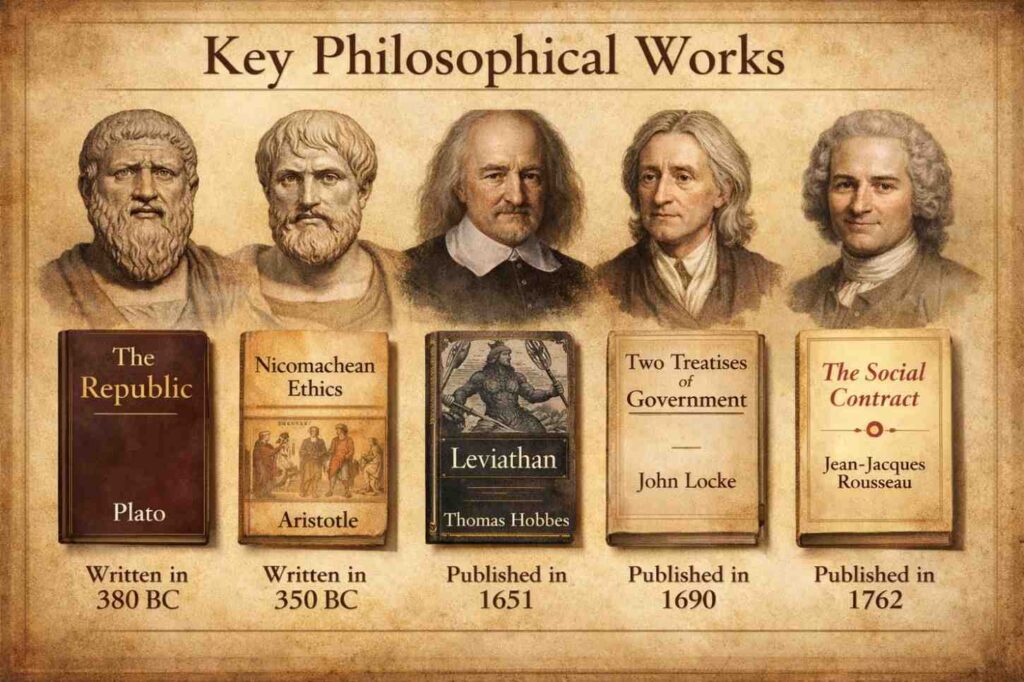
Western and modern political thought forms a core area of the NTA UGC NET Political Science syllabus. It examines the ideas of major thinkers who shaped political concepts such as the state, liberty, equality, democracy, and justice. Classical Western thinkers like Plato (The Republic) and Aristotle (Politics) laid the foundations of political philosophy by analyzing ideal states and constitutional forms. In the modern period, Niccolò Machiavelli’s The Prince introduced a realistic approach to power and statecraft. Thomas Hobbes in Leviathan emphasized absolute sovereignty to avoid anarchy, while John Locke’s Two Treatises of Government advocated natural rights and limited government. Jean-Jacques Rousseau, through The Social Contract, stressed popular sovereignty and the general will. Nineteenth-century thought is dominated by Karl Marx’s The Communist Manifesto and Das Kapital, which offered a critique of capitalism. Later thinkers like John Stuart Mill (On Liberty) and John Rawls (A Theory of Justice) enriched liberal and democratic
| 41. The Art of Thought | Graham Wallas | 1926 |
| 42. Property and Society | Graham Wallas | 1918 |
| 43. Our Social Heritage | Graham Wallas | 1921 |
| 44. Political Behavior | Herbert H. Hyman | 1959 |
| 45. Behaviorism in Political Science | Heinz Eulau | 1963 |
| 46. Behavioral Persuasion in Politics | Heinz Eulau | 1963 |
| 47. The Science and Method of Politics | George E. G. Catlin | 1927 |
| 48. Psychopathology and Politics | Harold D. Lasswell | 1930 |
| 49. Quantitative Methods in Politics | Stuart A. Rice | 1928 |
| 50. Physics and Politics | Walter Bagehot | 1872 |
| 51. The Limits of Behaviorism | James Charlesworth | 1962 |
| 52. Systematic Politics | George E. G. Catlin | 1962 |
| 53. Liberalism Ancient and Modern | Leo Strauss | |
| 54. The Political System | David Easton | 1953 |
| 55. A Framework for Political Analysis | David Easton | 1965 |
| 56. A Vindication of the Rights of Woman | Mary Wollstonecraft | 1792 |
| 57. The Book of the City of Ladies | Christine de Pizan | 1405 |
| 58. The Feminine Mystique | Betty Friedan | 1963 |
| 59. Sexual Politics | Kate Millett | 1970 |
| 60. The Second Sex | Simone de Beauvoir | 1949 |
| 61. The Discourses | Niccolò Machiavelli | 1531 |
| 62. Man and Society | John Plamenatz | 1963 |
| 63. The Ruling Class | Gaetano Mosca | 1896 |
| 64. Two Treatises of Government | John Locke | 1689 |
| 65. The Social Contract | Jean-Jacques Rousseau | 1762 |
| 66. Political Economy | Jean-Jacques Rousseau | 1755 |
| 67. Emile | Jean-Jacques Rousseau | 1762 |
| 68. Leviathan Thomas | Hobbes | 1651 |
| 69. The Nature of the State | Willoughby Walling | 1896 |
| 70. De Cive Thomas | Hobbes | 1642 |
Feminist and Behavioural Political Thought and Their Works
Feminist political thought critiques traditional political theory for ignoring women’s experiences and gender-based power relations. It highlights issues of patriarchy, equality, representation, and justice. Feminist thinkers argue that the personal is political and that political structures sustain gender inequality. Important works include Mary Wollstonecraft’s A Vindication of the Rights of Woman, which demands equal rights and education for women; Simone de Beauvoir’s The Second Sex, which analyses women’s oppression as socially constructed; and Carole Pateman’s The Sexual Contract, which critiques liberal democracy for excluding women. Feminism has expanded political analysis to include family, care, and identity.
Behavioural political thought emerged in the 20th century as a scientific approach to politics, focusing on observable political behaviour rather than normative ideas. It emphasizes empirical research, psychology, and data analysis. Key works include Graham Wallas’ Human Nature in Politics and Arthur F. Bentley’s The Process of Government. Behaviouralism aimed to make political science more objective and systematic.
| 71. De Corpore | Thomas Hobbes | 1655 |
| 72. De Homine | Thomas Hobbes | 1658 |
| 73. The Common Laws | Thomas Hobbes | 1651 |
| 74. Historia Ecclesiastica | Thomas Hobbes | 1688 |
| 75. Behemoth | Thomas Hobbes | 1681 |
| 76. Some Thoughts Concerning Education | John Locke | 1693 |
| 77. Letters Concerning Toleration | John Locke | 1689 |
| 78. Elements of Natural Philosophy | John Locke | 1698 |
| 79. Discourse on Inequality | Jean-Jacques Rousseau | 1755 |
| 80. Letter from the Mountain | Jean-Jacques Rousseau | 1764 |
| 81. Confessions | Jean-Jacques Rousseau | 1782 |
| 82. On Education | Jean-Jacques Rousseau | 1762 |
| 83. Discourse on the Arts and Sciences | Jean-Jacques Rousseau | 1750 |
| 84. The Marxist Theory of the State | Ernest Mandel | 1971 |
| 85. The State in Capitalist Society | Ralph Miliband | 1969 |
| 86. Marxism and Politics | Ralph Miliband | 1977 |
| 87. Political Power and Social Classes | Nicos Poulantzas | 1968 |
| 88. The Open Society and Its Enemies | Karl Popper | 1945 |
| 89. The Power Elite | C. Wright Mills | 1956 |
| 90. Dialectical Materialism | Maurice Cornforth | 1953 |
| 91. Dialectical and Historical Materialism Joseph Stalin 1938 | Joseph Stalin | 1938 |
| 92. Problems of Leninism | Joseph Stalin | 1924 |
| 93. Foundations of Leninism | Joseph Stalin | 1924 |
| 94. What the “Friends of the People” Are | Vladimir Lenin | 1894 |
| 95. Iskra | Vladimir Lenin (Edited) | 1900 |
| 96. Pravda | Joseph Stalin (Edited) | 1912 |
| 97. The Philosophy of Poverty | Pierre-Joseph Proudhon | 1847 |
| 98. Critique of Pure Reason | Immanuel Kant | 1781 |
| 99. Principles of Political Obligation | T. H. Green | 1895 |
| 100. The Metaphysical Theory of the State | L. T. Hobhouse | 1918 |