Father of Political Science & Major Theories, and Importance of the Subject
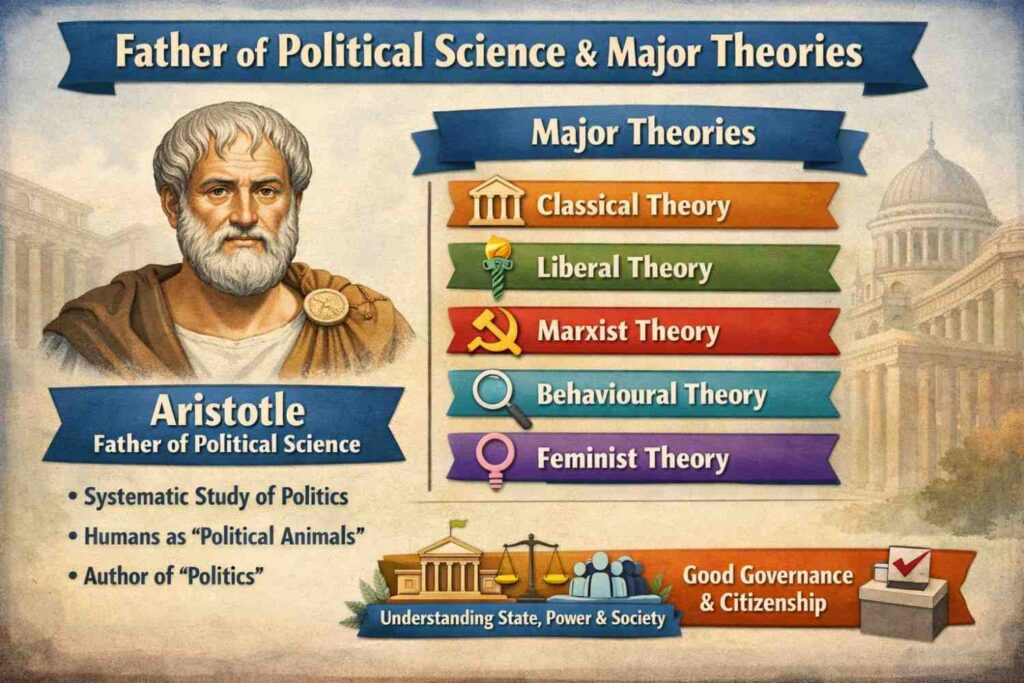
Aristotle is widely regarded as the Father of Political Science & Major Theories. He was a Greek philosopher and a student of Plato. Aristotle gave political study a systematic and scientific approach. His famous work Politics analyzed constitutions, citizenship, justice, and forms of government based on empirical observation. He defined the state as a natural institution and described humans as political animals, emphasizing the ethical purpose of politics.
Political Science has developed several major theories over time.
The Classical Theory focuses on ethics, justice, and the ideal state, as seen in Plato and Aristotle.
The Liberal Theory emphasizes individual liberty, rights, and constitutional government, represented by thinkers like John Locke and J.S. Mill.
The Marxist Theory analyzes politics through class struggle and economic relations, introduced by Karl Marx.
The Behavioural Theory studies political behavior using scientific and empirical methods.
The Feminist Theory highlights gender inequality and women’s role in politics.
The importance of Political Science lies in its study of the state, power, government, and public policy. It helps citizens understand political institutions, democratic values, rights, and duties. Political Science also promotes political awareness, good governance, and informed participation, making it essential for a healthy democratic society.
Q1. Who is the father of Political Science?
Ans: Aristotle
Q2. Who is the father of the Comparative Approach?
Ans: Aristotle
Q3. Who is the father of the Philosophical Approach?
Ans: Plato
Q4. Who is the father of the Legal Approach?
Ans: A. V. Dicey
Q5. Who is the father of the Historical Approach?
Ans: Ivor Jennings
Q6. Who is the father of Modern Political Science?
Ans: Niccolò Machiavelli
Q7. Who is the father of Public Administration?
Ans: Woodrow Wilson
Q8. Who is the father of the Modern Nation State?
Ans: Jean Bodin
Q9. Who is the father of the Theory of Sovereignty (Monistic)?
Ans: Thomas Hobbes
Q10. Who is the father of the Pluralistic Theory of Sovereignty?
Ans: Harold Laski
Q11. Who is the father of Legal Sovereignty?
Ans: Thomas Hobbes
Q12. Who is the father of Political Sovereignty?
Ans: John Locke
Q13. Who is the father of Democracy (Classical)?
Ans: Cleisthenes
Q14. Who is the father of Pluralist Democracy?
Ans: Robert A. Dahl
Q15. Who is the father of Socialist Democracy?
Ans: V. I. Lenin
Q16. Who is the father of Utopian Socialism?
Ans: Thomas More
Q17. Who are the fathers of Scientific Socialism?
Ans: Karl Marx and Friedrich Engels
Q18. Who is the father of Guild Socialism?
Ans: A. J. Penty
Q19. Who is the father of Syndicalism?
Ans: Fernand Pelloutier
Q20. Who is the father of Democratic Socialism?
Ans: Ferdinand Lassalle
Q21. Who is the father of Anarchism?
Ans: Joseph Proudhon
Q22. Who is the father of the Idea of Law?
Ans: Cicero
Q23. Who is the father of International Law?
Ans: Hugo Grotius
Q24. Who is the father of Liberalism?
Ans: John Locke
Q25. Who is the father of Individualism?
Ans: Jeremy Bentham
Q26. Who is the father of the Concept of Public Opinion?
Ans: Jean-Jacques Rousseau
Q27. Who is the father of the Idea of Constitution?
Ans: James Madison
Q28. Who is the father of the Indian Constitution?
Ans: Dr. B. R. Ambedkar
Q29. Who is the father of the Concept of Bureaucracy?
Ans: Max Weber
Q30. Who is the father of Idealism?
Ans: G. W. F. Hegel
Q31. Who is the father of Behaviouralism?
Ans: Graham Wallas
Q32. Who is the father of Group Theory?
Ans: Arthur Bentley
Q33. Who is the father of Systems Theory in Political Science?
Ans: David Easton
Q34. Who is the father of Indian Political Science?
Ans: Kautilya (Chanakya)
Q35. Who is the father of Modern India?
Ans: Raja Ram Mohan Roy
Q36. Who is the father of the Indian Nation?
Ans: Mahatma Gandhi
Q37. Who is the father of Indian Law?
Ans: Dr. B. R. Ambedkar